The syllabus of any class can be compared to the map that will guide you through the semester. The syllabus provides you with an overview of the “geographical” territory you will cover in order to get to your final destination (Ko & Rossen, 2010). Being as detailed and explicit as possible will hopefully avoid any misunderstandings or misconstrued ideas. Clarity and specificity are important factors when creating a syllabus, it can be seen as a “contract” between student and professor stating both parties responsibilities and expectations (Ko & Rossen, 2010). It is somewhat of the “key” that opens the door of a new semester, a new beginning.
The interactive syllabus can definitely attract students’ attention and not overlook important information. It is amazing what the human brain can do. Newer generations can be multi-tasking and may overlook important information on the syllabus or any document or statements for that matter. Visual aids and multi-media can definitely enhance such an important document. Pilar’s video mentions organizing the syllabus and integrating Wimba onto the first page, I believe, for voice instruction. I have never used Wimba, but it seems an avenue I would definitely like to explore. As mentioned in the youtube video: “color, images, hyperlinks, organization can appeal to students”. I, myself, am a very visual person and as a student I would always look for bolds, italics, color codes, etc on my class syllabus. As soon as I would register for the course I was eager to go over the syllabus and class calendar to have a visual and overview of what the class would be like. Small details can go a long way.
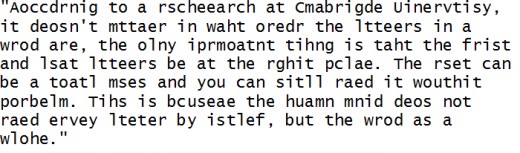
Point in case, when looking for my youtube video, the video with color in the still picture for the link grabbed my attention. Granted it was a long video it definitely made me look into it and skimmed through the video and found some useful mentions of online tools. Another interesting factor is how we can scan information and still somewhat make sense of it (picture below). Competing to get student’s focus and attention where attention is needed can be a challenge. With online courses we can take advantage of technology and add visual aids, hyperlinks, audios, etc… These “aids” can help the spectators/ students pause and really think of what the information is stating and take the information in and process it.