
Monthly Archives: November 2014

A Whole Lot of Sharing Going On

https://c1.staticflickr.com/9/8056/8100966908_d734cd2894_z.jpg

Online educators are in a great position these days to take advantage of so many opportunities for networking. Not too long ago, the way I would network with fellow educators was by attending conferences that were far away and a hassle to get to. In the present, however, support and ideas for improving my teaching are literally a click away.

In the video “Sharing: A Moral Imperative”, the narrator states that we are on the verge of a “sharing” revolution. The stats provided in Alex Couros’ video make this more than clear! I believe there are times when sharing is valuable and appropriate, and there are times when it is simply sharing overkill. The most relevant and useful sharing occurs when educators offer their experiences with teaching techniques, technologies, classroom management, pedagogy, etc. However, I must ask how the busy instructor can expect to keep up with all of the “sharing” that is out there? I like the idea of the personal learning network (PLN) proposed by Helen Crump. Putting a filtering system in place that limits the people, articles and books and professional activities I engage with and in would certainly make “sharing” more manageable. I discovered this easy-peasy link on how to build your own PLN along with a video explaining more about what a PLN is.

https://www.youtube.com/watch?feature=player_embedded&v=hLLpWqp-owo

There is a lot of opportunity to learn from what others share, but what about me “sharing” with other educators? I have seen from this class the benefits of sharing blogs, and I plan to continue blogging after this class. The “Virtues of Blogging” article prompted questions for me because though I find blogging valuable, up to this point I haven’t considered blogs as recognized professional publications. In Weller’s article, he states “..it would be difficult to argue that the blog does not constitute widely accepted definitions of scholarly research.” But I would argue that blogs do not fit the definition of scholarly research because many blogs are written from a particular political perspective, they are not usually peer-reviewed prior to publication, and they often do not reference where the factual information presented came from. But if the academic community recognizes blogs as scholarly research, and educators are expected to publish them, then I would much rather post a blog than go through all of the red tape and waiting that comes with publishing a journal article!

Is sharing a moral imperative? I rather agree more with the statement that it’s an “ethical responsibility”. I was touched by the anecdotes in the “Sharing” video as folks described the positive experiences people had with sharing photos and stories. And I agree that people generally enjoy sharing themselves – just look at all of the minutiae people post on Facebook! I also agree with the importance Ko and Rossen place on networking with others and continually seeking to update/improve our online teaching skills. Though I recoil at the suggestion that the online learning “marketplace” dictates the pace of change instructors are expected to keep up with, my experience is that this is true. We must help each other if we’re to keep up with the rapidly evolving landscape of online education.

On another note, in all honesty I have no idea what I will do my final presentation on. It will largely depend on which Web 2.0 tool I am most comfortable using at this point. The changes I want to make in the short term in my classes are adding a welcome video, providing an online class tour, developing a presentation via Prezi, and creating a group project where students present their final product as either a wiki or a blog. I’d love to hear everyone’s input on these ideas and get some clarity.
Online Education Outside the Box

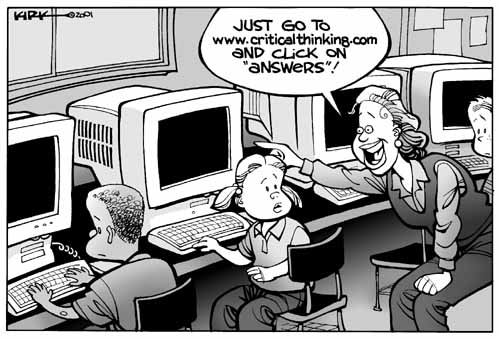
critical-thinking-cartoon

This POT training has opened my eyes to the many options and possibilities for online teaching. I have to admit that I feel like I started this class as a well-intentioned but naive online instructor, and while I am now intimidated and overwhelmed by the options that I now know are available to me I am also grateful for the education. I now have the tools to step out of my own comfortable little box and provide my students with a more effective and interactive online learning experience.

From our lessons, I’ve been able to evaluate what changes I think will be best for me as an instructor and also for the specific discipline that I teach. I also feel that the age and experience of the students should determine how online classes are constructed. For example, the setup for an online class whose demographic primarily consists of undergraduate students taking an introductory online class might be different from an online class for graduate students just as it is in the face-to-face classroom.

Because I teach undergraduate students, most of whom are between 18-20 years old (and some of whom are taking their first online class ever), I would definitely avoid overcomplicating my online classes and making them appear chaotic to students. Cris Crissman presented the continuum of centralized vs. decentralized online education, and the postulated the idea of online education with no central hub. This seems to me to be a very chaotic approach. But perhaps I don’t yet appreciate the value of the “no hub” online class because I haven’t yet observed an educator who does this, so I don’t really understand how it’s supposed to work. I do know that the Digital Ethnography example only made me more averse to this type of class. I couldn’t make heads or tails of what was going on in there! What were students supposed to be posting and blogging about? What were they supposed to be reading or researching? Going into an online classroom like that would give me a huge headache! I’m assuming that the professor provided some type of instruction that I didn’t find on the website (at least I hope so!).

I feel as though I’ve already expressed this sentiment in my previous blogs, but I still feel strongly that the instructor’s job is not just to get students using all of the latest technology to complete their coursework. The instructor is also responsible for clearly communicating what is expected in the course and how students can meet those expectations. In this regard, I concur with the survey results in the “Using Online Technologies” article. When asked, “What could have been done to make this (open education) course a better experience for you?”, some of the responses referenced students’ uncertainty about how to progress in the course: “The timeline of the course was somewhat confusing,” and “I have lacked information on the progress of the course”.

In summary, I am all for using new and innovative approaches and technologies in online education if they improve the learning and the experience for the student. It’s only when these approaches and technologies confuse or overwhelm students that they’re not appropriate.

Thoughts on Online Education Theory

Online education has forced educators to reevaluate their teaching philosophies, and there is much discussion about the various pedagogical philosophies and how to integrate/synthesize them. It seems we are on the verge of identifying a new approach to online education that attempts to bring the pendulum back into the middle, with behaviorism on the one side and connectivism on the other (see George Siemens’ brief summary of Connectivist Learning Theory), and cognitivism and constructivism somewhere in the middle. All of the readings this week seem to address the tension between the various pedagogical theories and how this tension may be resolved.

The readings also debate the revolutionary qualities of using the Internet for education and the potential it has for turning students into mindless robots with the ability to use technology for the purpose of accessing and obtaining information, but with little ability for self-invention.

My beliefs about education tend to fall somewhere in the middle of this continuum. I agree that there is a place for traditional approaches to education (e.g. memorization and lectures), and I also believe that knowledge may be constructed and obtained socially and externally. Interestingly enough, this has been a topic of discussion among the parents at my son’s elementary school as they introduce the Common Core State Standards that California and a number of other states have adopted. Parents were recently given an opportunity to observe a sample math lesson designed to meet the Common Core standards. Much of the focus was on getting students to identify patterns and develop strategies to solve problems. While it was obvious the students were using their critical thinking skills, a number of parents (myself included) questioned why the students weren’t also being taught how to add double digit numbers using the old-school column method (remember to carry the one!). We felt that students needed to learn BOTH in order to both arrive at the correct answer to an easy-to-solve problem quickly and to apply strategies for solving new types of problems.


It seems to me that if education continues to go the way of connectivism, the knowledge we have as instructors of a specific discipline will diminish in importance. Will instructors and good old-fashioned books become irrelevant as Sanger suggests? Or will the knowledge we have obtained benefit our students because we can guide and redirect them when their self-constructed knowledge goes awry? I hope I won’t just become a “classroom guide” to my students, showing them how to use various Web 2.0 tools and connecting them with other students in the class. My hope is that I will continue to play an important role in sharing information with my students, while simultaneously learning with them and from them.

Managing the Online Classroom

Ok, my brain hurts after all of the reading for this week. But the different perspectives on how a CMS/LMS may impact my pedagogy, class design and class management were very thought provoking.

The two community colleges where I teach online both use Blackboard as their CMS. For all of these years, I have been content with that platform and I had never even considered using an alternative LMS until this week. I’m not sure if I even have the choice where I teach. But I am now thinking about the hard and soft landscapes that Eric Robertson described in his video, and I am asking myself if there is anything that Blackboard does not do that I really want to do on my classes. I appreciate that Eric mentioned that instructors should consider not only what’s available but also what will maximize their strengths. Perhaps another CMS would better enable me to let my real teaching style come through.

I readily admit that I was a novice when I first began teaching online. There were no classes offered about how to use the various technologies or about how to transfer pedagogical practices and philosophies to the online environment. And even as I’ve become more of a seasoned online instructor, I can still observe more lack of Web 2.0 know-how than I’d like to see in myself. You would think this would motivate me to learn more about the technologies available to me to improve my online teaching, but one of the sentences in Lisa’s article describes me well: “They [online instructors] want speed and ease of use rather than more features.” Yep, that’s me!

At the same time, I firmly disagree with the statement in Lisa’s article that “Novices happily use the high-tech CMS as a glorified copy machine”. Though I am guilty of uploading Word documents and .pdf’s into my online classes and writing text in the designated WISYWIG boxes, I don’t feel that this has undermined my teaching. I believe what’s important is finding a happy medium between the overuse of Web 2.0 and not taking advantage of what the various technologies have to offer. I don’t want to overwhelm my students with too many bells and whistles and bog them down with all of the instructions I would need to give them. Some features would definitely detract from the objectives I’m trying to achieve in my courses. But I am very open to adding features that will enhance the online education experience for my students. Just this morning I was given a demo from my classroom textbook’s publisher explaining their own LMS, and I definitely discovered aspects that I could incorporate into my own CMS!

On the other hand, I am resistant to incorporating some new features because I get so frustrated with technical problems that often result. Case in point: It’s been a week now that I can’t read any of your blogs nor can I access my own blog on WordPress! Anthony Ginger at MiraCosta is working on this, but for now I have to type my blogs into my iPad. Also, I still have not been able to figure out how to get my webcam and microphone to work. I may have to call in one of the Geek squad to come and figure this out. That or I might just take a sledgehammer to my computer! I really don’t want to put my students through this kind of frustration by making them use all sorts of tools when some of them are just learning how to navigate through Blackboard.

It’s interesting that Ko and Rossen outline the bare basics of classroom management while the three articles discuss how modern online teaching transcends these elements. After all is said and done, I believe a happy medium between the linear “cognitive-behaviorist” approach and the “connectivist” approach benefits students most. As the three generations article explains, “Learning in connectivist space is, paradoxically, plagued by a lack of connection. In connectivist space, structure is unevenly distributed and often emergent, with that emergence seldom leading to structure that is optimally efficient for achieving learning goals.” As with everything we are learning in this POT class, the essential question is will this feature, function or CMS/LMS enhance or detract from my teaching and goals for this class? 

I discovered a site that describes numerous class management software programs. My apologies, but you may have to copy and paste the link.:-(

http://www.capterra.com/classroom-management-software/


Getting Students Ready for Online Learning

Online Physical Geography

Frequently Asked Questions (FAQs)


1. Do I have to use the same textbook edition as the instructor, or can I use a previous edition of the text?

Students are welcome to use a previous edition of the required textbook. Generally, the information in previous editions is the same with a few minor exceptions. However, it is important to note that the page numbers I reference in the online lectures and in announcements will likely not correspond to the page numbers in previous textbook editions. Also, the graphics and tables are obviously more current in the most recent edition.


2. When will grades be posted?

Grades will be posted on Blackboard within one week of an assignment due date on Monday, e.g. grades for the Introductions Assignment (due by Monday, August 25th) will be available on Blackboard by Monday, September 1st. Grades will generally be posted earlier, but it is not guaranteed. Note: The one week grade posting applies only to those materials that the instructor must grade, e.g. discussion boards and assignments that have short answer questions. Grades that are automatically calculated by Blackboard, such as quizzes consisting exclusively of multiple choice questions, should reflect in the Blackboard grade book immediately after an assignment/exam is submitted.


3. Is there extra credit in this class?

I generally do not offer extra credit, though there may be an extra credit opportunity or two if a relevant event comes up that I want to encourage students to attend.


4. If I miss an assignment, will I be able to complete the assignment late for partial credit?

Make up work (including exams) will not be accepted other than for extreme emergencies that can be verified in official written form, e.g. doctor’s note, etc. Students requesting to make up missed work MUST contact me before the assignment deadline (unless the emergency prohibits). It is highly recommended that students give themselves plenty of time to complete the required assignments and exams. Waiting until 11:00 p.m. on the Monday evening that something is due increases the probability that your work will not arrive electronically by 11:59 p.m., and I do not accept late work (that includes work turned in at 12:00 a.m.)! If your computer crashes or some other glitch occurs at the last minute (including illness), it will be too late for me to help you.


5. Will you round up my grade when I am only 1% from an A?

The grading scale for this class is as follows: 90-100=A, 80-89=B, 70-79=C, 60-69=D, 0-59=F. A student’s final grade is determined objectively by how many points he/she earns out of the total possible points. Though I appreciate that a student has worked very hard to earn an A, grades are not determined subjectively. And in fairness to all students it is only ethical to stick to the grading scale.


Here is the link to the very short survey. Sorry I can’t hyperlink it – I’m typing this on my iPad due to technical difficulties with my PC and WordPress.:-(

https://www.surveymonkey.com/s/3D5LQDS